What Is Cyber Insurance: An Educational Guide for Agencies & MSPs
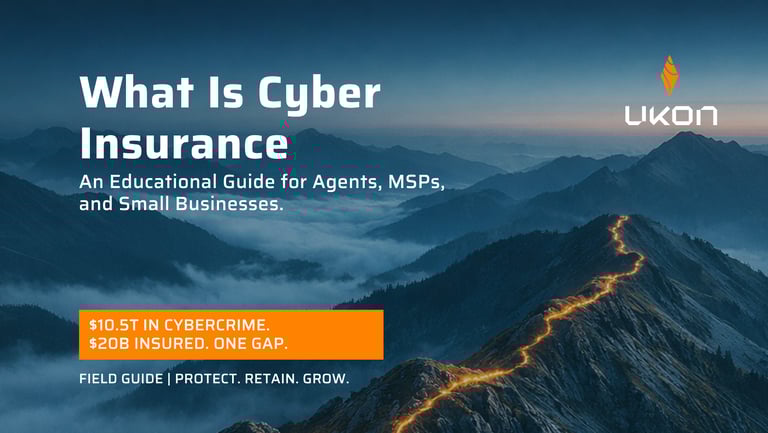
Cyber insurance is the financial safety net that funds a business's response when a cyberattack defeats its defenses. This guide explains what cyber insurance covers, why most businesses remain unprotected, and how agents, MSPs, and small business owners can close the gap before the next incident arrives.
THOUGHT LEADERSHIP
3/27/202616 min read

TL;DR: What We Understand
Cyber insurance is a standalone policy that covers the costs of responding to a cyberattack, including forensic investigation, customer notification, legal defense, ransomware negotiation, and lost revenue during downtime.
Global cybercrime losses now exceed $10.5 trillion annually, while global cyber insurance premiums remain around $20 billion. That distance between exposure and protection is called the Cyber Protection Gap.
Only 10 to 20% of SMEs carry a dedicated cyber insurance policy. The vast majority are crossing an increasingly hostile digital frontier with no financial map.
General liability and Business Owner's Policies do not cover cyber incidents. Most policies issued after 2019 contain explicit cyber exclusions.
The barrier to closing the gap is not product availability, carrier appetite, or even price. It is a distribution and infrastructure problem inside insurance agencies that lack the operational capacity to run cyber as a repeatable practice.
For agents: Cyber Practice Leadership installs an outsourced cyber department inside your agency, making cyber a managed capability rather than a reactive placement.
For MSPs: A Risk Spectrum Assessment aligns your cybersecurity services with the insurance requirements your clients actually face, reducing Tech E&O exposure and strengthening your advisory role.
For small businesses: The most important step you can take today is to ask your insurance agent whether your current policy covers a cyber event. If the answer is unclear, that is the gap.
Key Metrics for Cyber Insurance
Understanding the scale of the Cyber Protection Gap requires looking at the numbers side by side. These are not projections from a decade-old forecast. They reflect the current state of the market as of early 2026.
Annual global cybercrime losses: $10.5 trillion+ (Cybersecurity Ventures (2026))
Global cyber insurance premiums: ~$20.5 billion (Heimdal Security / Research and Markets)
First-order economic losses from cyber attacks: $950 billion (GFIA Global Protection Gaps Study)
SMBs with dedicated cyber insurance: 10-20% (Actuary.org / Swiss Re)
Average ransomware claim loss (2025): $269,000 (Coalition 2026 Cyber Claims Report)
FBI IC3 reported losses (2024): $16.6 billion (FBI IC3 / DeepStrike)
Difference between insured and economic losses: $2.5 trillion (Insurance Business Magazine)
The pattern is unmistakable. Cybercrime operates at the scale of a national economy. The insurance infrastructure designed to protect against it covers a fraction of the exposure. Every number in this table points to the same conclusion: the gap is structural, it is widening, and it requires a fundamentally different approach to close.
What Is Cyber Insurance?
The Cyber Protection Gap is the widening distance between real-world digital exposure and the structured financial protection businesses actually carry. It is the defining challenge of the modern insurance industry, and it is growing faster than any single carrier, agency, or technology vendor can address alone.
The Global Federation of Insurance Associations quantified the gap in its landmark 2023 study: first-order economic losses from cyber attacks reach approximately $950 billion annually, while insured losses sit at roughly $60 billion. That leaves nearly $900 billion in uninsured cyber exposure every year, and the majority of that exposure sits with small and mid-sized businesses.
Munich Re's analysis reinforces the same pattern. Global cyber insurance premiums have doubled since 2020 and the market now exceeds $20 billion, yet the vast majority of cyber risk remains uninsured. According to Actuary.org's February 2026 market assessment, only 10 to 20% of SMEs with $10 million to $100 million in revenue purchase cyber insurance, and the figure drops to 5 to 10% for micro businesses below $10 million. The gap persists not because coverage is unavailable, but because the distribution infrastructure that connects carriers to businesses has not adapted to the complexity of cyber risk.
Insurance Business Magazine captured the challenge directly: "We are the insurance industry and people are not buying insurance." The article notes that the difference between insured and economic losses across all lines now reaches $2.5 trillion, with cyber representing one of the fastest-growing contributors to that figure. Christopher Croft, the article's author, states plainly that "cyber insurance is available and it is not that expensive. And yet the data shows us that firms, particularly SME businesses, are not buying it."
The Actuaries Institute of Australia found that the gap is widening specifically among SMEs, driven by a combination of factors: the belief that cybersecurity is "too hard," the assumption that their business is "too small to target," and the reality that cyber insurance remains unfamiliar territory for both business owners and many of the agents advising them.
This is the misconception at the heart of the problem. The gap is not a product gap. It is a knowledge gap.
The Cyber Protection Gap is the widening distance between real-world digital exposure and the structured financial protection businesses actually carry. It is the defining challenge of the modern insurance industry, and it is growing faster than any single carrier, agency, or technology vendor can address alone.
The Global Federation of Insurance Associations quantified the gap in its landmark 2023 study: first-order economic losses from cyber attacks reach approximately $950 billion annually, while insured losses sit at roughly $60 billion. That leaves nearly $900 billion in uninsured cyber exposure every year, and the majority of that exposure sits with small and mid-sized businesses.
Munich Re's analysis reinforces the same pattern. Global cyber insurance premiums have doubled since 2020 and the market now exceeds $20 billion, yet the vast majority of cyber risk remains uninsured. According to Actuary.org's February 2026 market assessment, only 10 to 20% of SMEs with $10 million to $100 million in revenue purchase cyber insurance, and the figure drops to 5 to 10% for micro businesses below $10 million. The gap persists not because coverage is unavailable, but because the distribution infrastructure that connects carriers to businesses has not adapted to the complexity of cyber risk.
Insurance Business Magazine captured the challenge directly: "We are the insurance industry and people are not buying insurance." Christopher Croft, the article's author, states plainly that "cyber insurance is available and it is not that expensive. And yet the data shows us that firms, particularly SME businesses, are not buying it." Meanwhile, the Actuaries Institute of Australia found that the gap is widening specifically among SMEs, driven by a combination of factors: the belief that cybersecurity is "too hard," the assumption that their business is "too small to target," and the reality that cyber insurance remains unfamiliar territory for both business owners and many of the agents advising them.
This is the misconception at the heart of the problem. The gap is not a product gap. It is a knowledge gap.
The Cyber Protection Gap: Why Most Businesses Remain Unprotected
When UKON engages with independent agencies across the country, two responses surface more than any others.
The first: "Our clients don't want it. They don't ask about it. They don't care about it."
The second: "I know my clients need it, I've tried to sell cyber insurance, but I don't know how. Clients aren't interested, or they don't understand it."
Both responses point to the same root cause. The conversation about cyber insurance either never happens, or it happens without the structure and confidence required to move a client from awareness to action.
The reality is that clients do care, even if they have not yet said so.
Munich Re's 2026 Cyber Risk and Insurance Survey found that nine out of ten C-level executives worldwide consider their companies inadequately protected against cyber risk. The demand exists. What does not exist, in most agencies, is the operating infrastructure to surface that demand, translate it into a structured conversation, and convert it into a bound policy.
This is not a failure of individual producers. It is a structural constraint inside distribution. Cyber insurance requires collecting technical risk data that most commercial lines workflows were never designed to handle: MFA posture, backup architecture, endpoint detection tools, incident response documentation, vendor exposure, data sensitivity classifications, and revenue-to-risk ratios. Without a repeatable system for gathering, organizing, and presenting that information, the cyber conversation stalls before it starts.
Swiss Re's September 2025 SME cyber analysis identified agent and broker confidence as a structural barrier to coverage penetration. The constraint is not that producers lack talent. The constraint is that they lack capacity, the infrastructure, workflow, and specialist support required to make cyber a consistent, repeatable part of every commercial renewal.
Two Conversations That Often Reveal The Gap
For independent agents, the Cyber Protection Gap creates a second, more personal risk: errors and omissions exposure.
When an agency fails to offer, discuss, or document a cyber insurance conversation at renewal, and the client subsequently suffers a cyber incident, the agency faces a potential E&O claim. The client's argument is straightforward: "My agent never told me I needed this. My agent never asked. If they had, I would have purchased it."
This is not a theoretical risk. Munich Re's 2026 analysis of emerging professional liability risks warns that even agencies that do not specialize in cyber insurance increasingly field cyber-related questions, and that "a casual suggestion about cybersecurity practices, or an off-the-cuff explanation of a complex cyber exclusion, may later be scrutinized as professional advice." The advisory gray area is expanding. Agencies need to ensure their staff understand where the advisory role begins and ends, and that their E&O policies contemplate the conversations they are already having.
The prudent response is not to panic. It is to build a process. Every renewal should include a documented cyber conversation, whether the client purchases coverage or not. The documentation protects the agency. The conversation protects the client. And a structured system for delivering both, consistently across every account, protects the entire book of business.
As UKON's field guide for agents states plainly: "The failure to offer, discuss, and document cyber at renewal is the primary mechanism for E&O claims in this category." The solution is not to become a cyber expert overnight. It is to have the operating discipline and specialist support that ensures cyber is addressed on every account, every renewal, every time.
The E&O Exposure That Agents Cannot Afford to Ignore
One of the most persistent misconceptions about cyber insurance is that it is expensive. The data says otherwise.
Small businesses typically pay $750 to $2,500 per year for $1,000,000 in cyber insurance coverage. A professional services firm with strong security controls, including multi-factor authentication, endpoint detection, tested backups, and annual training, can secure a $1,000,000 policy for $1,200 to $1,800 per year. Healthcare and financial services firms pay 30 to 40% above the baseline due to elevated regulatory exposure, but even those premiums remain a fraction of the cost of a single incident.
Compare that to the cost of responding to an attack without insurance:
Average ransomware claim loss: $269,000 (Coalition 2026 Cyber Claims Report)
Average breach cost for a small business: $200,000
Forensic investigation: $15,000 to $50,000
Customer notification for 5,000 records: $40,000 to $75,000
Legal defense: $145,000 to $280,000
Total restoration after a $35,000 ransom payment: $105,000 to $140,000
The math is not complicated. A policy that costs $1,500 per year protects against incidents that routinely reach six figures. The price of cyber insurance is not the barrier. The barrier is that the conversation never happened.
The Lockton 2026 Cyber Insurance Market Update confirms that premiums actually fell by an average of 11% in 2025, even as incidents surged to unprecedented levels. Coverage is broadening. Pricing is competitive. The market conditions have never been more favorable for businesses seeking cyber protection. What remains absent, for the majority of commercial accounts, is the structured insurance conversation that connects available coverage to real exposure.
What Cyber Insurance Costs (And Why The Price Is Not The Problem)
The urgency is not theoretical. It is unfolding in real time.
Coalition's 2026 Cyber Claims Report, analyzing claims across more than 100,000 global policyholders, found that initial ransomware demands surged 47% year-over-year in 2025, with the average demand exceeding $1 million. Ransomware remained the most financially destructive category of cyber claim, averaging $269,000 in losses per event. Business email compromise and funds transfer fraud together accounted for 58% of all cyber incidents observed during the year, with the average funds transfer fraud loss reaching $141,000.
The FBI's Internet Crime Complaint Center reported $16.6 billion in losses from 859,532 complaints in 2024 alone, a 33% increase over the prior year. Business email compromise accounted for $2.77 billion of those losses.
On March 24, 2026, the FBI's Cyber Division issued a critical alert after the hacker crew TeamPCP breached two widely-used developer tools, Trivy and LiteLLM, in a supply chain attack that affected millions of users.
As Forbes reported, the group used AI to accelerate its attacks, exploiting weak security practices among organizations that had failed to verify the integrity of their software tools. The incident illustrates a pattern that every business owner, agent, and MSP should internalize: attackers are not slowing down. They are using the same technological acceleration that businesses depend on to move faster, at lower cost, with broader reach.
The Lockton market update noted a 129% increase in "nationally significant" cyber security incidents during the 12 months ending August 2025, according to the UK's National Cyber Security Centre. Some of the events observed in 2025 were modeled at the magnitude of a 1-in-100-year event, underscoring the accelerating severity of the threat landscape.
For small businesses, the picture is especially stark. Sixty percent of small businesses that suffer a major cyber incident do not reopen. These are not statistics about distant enterprises. These are the businesses sitting in every independent agent's book of business, relying on their advisor to help them understand what they face and what they can do about it.
What Is Happening Right Now: The 2025-2026 Threat Landscape
If the Cyber Protection Gap is a distribution and infrastructure problem, then the solution is not another product, another portal, or another webinar. The solution is an operating system. UKON's Cyber Practice Leadership is designed to address the structural constraint that keeps cyber insurance episodic inside most independent agencies. Rather than asking producers to become cyber experts, or expecting agencies to hire and train a $200,000 specialist, Cyber Practice Leadership installs an outsourced cyber department directly inside the agency.
Here is what that means in practice:
Diagnose and Align. UKON analyzes the agency's book of business, identifies uncovered cyber exposure across commercial accounts, and maps priority accounts by renewal timing and risk profile. More than 80% of commercial accounts in a typical independent agency carry no cyber coverage today, and the average uncaptured cyber revenue per agency book reaches $2.8 million.
Enable Producers. Producers receive the tools they need to lead confident cyber conversations: talk tracks, Cyber Guides, client-facing risk reports, and automated outreach sequences. The goal is not to turn a commercial lines producer into a cyber underwriter. It is to give them the trail gear they need to navigate the conversation and move the client toward protection.
Streamline Operations. UKON standardizes the cyber workflow: intake, submission preparation, carrier selection, renewal lookaheads, and pipeline reviews. The friction that causes cyber to stall inside traditional workflows, the scavenger hunt for technical risk data, the inconsistent documentation, the late-stage submissions, is replaced by a repeatable operating system.
Quote Intelligence. A dedicated Cyber Practice Leader, backed by cyber-specialist underwriting expertise, manages policy selection, carrier advocacy, and side-by-side coverage comparisons. The agency retains full ownership of the client relationship. UKON provides the technical backbone.
Claims and Support. When an incident occurs, UKON coordinates the response: triage, incident response partners, claims documentation, and carrier coordination from first notice through resolution. This is where the difference between a reactive placement and a managed practice becomes most visible, and most valuable to the client.
The model is commission-aligned. There is no upfront cost and no monthly retainer. UKON earns when the agency earns. The 90-Day CPL Trail moves an agency from book analysis in the first two weeks to producer enablement by day thirty, pipeline activation by day sixty, and a fully operational cyber practice with structured cadence and renewal discipline by day ninety.
As UKON's corporate story describes it: "The Cyber Protection Gap is a distribution and infrastructure problem. Agencies do not need more tools. They need capacity."
Cyber Practice Leadership: The Operating System That Closes The Gap
Managed Service Providers occupy a unique position in the cyber risk landscape. MSPs influence their clients' cybersecurity posture every day through the tools they deploy, the configurations they manage, and the monitoring they provide. Yet MSPs do not own the insurance relationship. They are essential participants in underwriting clarity, but they are not positioned, nor typically licensed, to drive insurance adoption.
This creates a specific exposure. When an MSP's client suffers a cyber incident and the insurance process begins, the MSP's work product becomes part of the investigation. Were the right controls in place? Were backups tested? Was the endpoint detection configured correctly? If the answers reveal gaps, the MSP faces potential Technology Errors and Omissions liability, claims alleging that the MSP's services failed to prevent the incident or contributed to its severity.
Tech E&O insurance protects MSPs against these claims, covering legal defense, settlements, and judgments related to professional negligence in the delivery of technology services. But most MSPs carry either no Tech E&O policy at all, or a policy that has not been reviewed against the current risk landscape.
UKON's Risk Spectrum Assessment provides MSPs with a structured review of how their cybersecurity services align with the insurance requirements their clients actually face. The assessment maps the MSP's service stack against carrier underwriting expectations, identifies gaps in documentation and controls, and produces a clear action plan for strengthening both the MSP's advisory role and its own liability protection.
For MSPs, the value proposition is direct: align your cybersecurity services with the insurance ecosystem, reduce your own E&O exposure, and become a more valuable partner to the agents and agencies that serve your shared clients.
How The Cyber Practice Operating System Supports MSPs
Cyber insurance underwriting has evolved significantly since 2022. Carriers no longer treat security controls as optional credit factors. They are now prerequisites for coverage. Understanding what underwriters require helps agents prepare better submissions, helps MSPs align their service offerings, and helps business owners take the steps that both reduce risk and lower premiums.
The four controls most carriers require for coverage:
Multi-factor authentication on all accounts and email
Carrier Requirement Rate: 98%
Impact: Reduces likelihood of successful attack by more than 99%Tested offline or immutable backups
Carrier Requirement Rate: 92%
Key differentiator in ransomware recoveryEndpoint detection and response tools
Carrier Requirement Rate: 87%
Traditional antivirus is no longer sufficientAnnual security awareness training
Carrier Requirement Rate: 76%
Human error contributes to approximately 95% of all cyber incidents
Businesses that implement all four controls typically receive premium reductions of 25 to 35%, bringing the average small business with strong security controls to approximately $1,200 to $1,500 per year for $1,000,000 in coverage. According to the GFIA study, prevention measures can decrease an organization's cyber risks by 70% and eliminate 80 to 90% of the costs of an incident if one occurs.
This is where agents, MSPs, and business owners converge. Agents who understand these controls can lead more productive underwriting conversations. MSPs who deliver these controls can document their value in the language carriers use. Business owners who implement these controls get better coverage at lower cost. The system works when everyone is working from the same map.
Security Controls That Affect Coverage and Cost
Next Steps
For Independent Agents and Agency Principals
The first step is a Cyber Practice Audit. This is a structured conversation where UKON reviews your agency's current cyber workflow, penetration across your book of business, and infrastructure. The audit identifies where gaps exist, quantifies the uncaptured opportunity, and maps a clear path to building cyber into a managed, repeatable line of business.
There is no cost for the audit and no obligation. The objective is clarity: where does your agency stand today, and what would a structured cyber practice look like inside your operation?
For MSPs and Technology Professionals
The first step is a Risk Spectrum Assessment. UKON reviews how your cybersecurity services align with carrier underwriting requirements, identifies gaps in your Tech E&O coverage, and produces an action plan for strengthening your position in the insurance ecosystem.
If you are advising clients on cybersecurity and your work product is part of the underwriting conversation, you need to know where you stand, both for your clients and for your own liability protection.
Request a Risk Spectrum Assessment
For Small Business Owners
Ask your insurance agent one question at your next renewal: "Does my current policy cover a cyber event?"
If the answer is unclear, or if your agent does not raise cyber insurance as part of the conversation, that is the gap. You can explore UKON's guide to cyber insurance for small businesses for a detailed breakdown of what coverage looks like, what it costs, and what questions to ask.
If your agent does not yet offer structured cyber advisory, you can find a UKON-partnered agency that does.
Frequently asked questions
What is cyber insurance?
Cyber insurance is a standalone insurance policy that covers the financial costs of responding to a cyberattack or data breach. Coverage typically includes forensic investigation, customer notification, legal defense, ransomware negotiation and payment, system restoration, and lost revenue during downtime. It divides into first-party coverage (costs the business absorbs directly) and third-party coverage (claims made against the business by customers, regulators, or partners). General liability and Business Owner's Policies do not cover cyber incidents in most standard forms issued after 2019.
What is the Cyber Protection Gap?
The Cyber Protection Gap is the widening distance between real-world digital exposure and the structured financial protection businesses actually carry through insurance and security controls. The Global Federation of Insurance Associations estimates first-order economic losses from cyber attacks at approximately $950 billion annually, against roughly $60 billion in insured losses. The gap persists because the insurance distribution infrastructure was not built to handle the technical complexity of cyber risk at scale.
How much does cyber insurance cost for a small business?
Small businesses typically pay $750 to $2,500 per year for $1,000,000 in coverage. Businesses with strong security controls, including MFA, endpoint detection, tested backups, and training, can secure coverage for $1,200 to $1,500 per year. Healthcare and financial services firms pay 30 to 40% above the baseline. Premiums fell by an average of 11% in 2025, making coverage more accessible than ever.
Does general liability insurance cover cyber attacks?
No. General liability policies issued after 2019 overwhelmingly exclude cyber incidents. Business Owner's Policies exclude cyber-caused business interruption in most standard forms. A ransomware claim filed under a general liability policy will, in nearly every case, be denied. A standalone cyber insurance policy is required for meaningful financial protection against cyber events.
Why do insurance agents struggle to sell cyber insurance?
Cyber insurance requires collecting technical risk information such as MFA posture, backup architecture, endpoint protection, and vendor exposure that most commercial lines workflows were not designed to handle. Submissions become a scavenger hunt without repeatable processes, and the conversation often surfaces too late in the renewal cycle to produce results. The barrier is not talent. It is infrastructure and operational capacity. UKON's Cyber Practice Leadership addresses this by embedding the infrastructure, specialist support, and workflow discipline that turns cyber from a reactive placement into a managed practice.
How do MSPs reduce their Tech E&O exposure?
MSPs reduce Tech E&O exposure by ensuring their cybersecurity services align with carrier underwriting requirements, maintaining clear documentation of controls deployed and recommendations made, and carrying adequate Tech E&O insurance that has been reviewed against the current risk landscape. A Risk Spectrum Assessment from UKON provides MSPs with a structured review and action plan tailored to their service stack and client base.
What security controls do businesses need to qualify for cyber insurance?
Most carriers now require multi-factor authentication (98% of carriers), tested offline or immutable backups (92%), endpoint detection and response tools (87%), and annual security awareness training (76%). Businesses that implement all four typically receive premium reductions of 25 to 35%. These controls are prerequisites for coverage, not optional credit factors.
What is UKON?
UKON is the Cyber Practice Operating System for independent commercial insurance agencies. Built on the foundation of FifthWall Solutions, the first cyber-only wholesale specialist, UKON operates at the intersection of risk mitigation and risk transference. Through Cyber Practice Leadership, UKON installs an outsourced cyber department inside agencies, combining book analysis, producer enablement, underwriting workflows, specialist support, and claims coordination into a managed operating system. The model is commission-aligned with no upfront cost, and agencies are typically operational within three weeks.
What is a Cyber Practice Audit?
A Cyber Practice Audit is a structured conversation where UKON reviews an agency's current cyber workflow, book penetration, and operational infrastructure. The audit identifies gaps, quantifies uncaptured opportunity, and produces a clear path to building cyber into a managed line of business. There is no cost and no obligation. Book a Cyber Practice Audit here..
What is a Risk Spectrum Assessment?
A Risk Spectrum Assessment is UKON's structured review for MSPs and technology professionals. It maps how an MSP's cybersecurity services align with carrier underwriting expectations, identifies gaps in Tech E&O coverage, and produces an action plan for strengthening both the MSP's advisory role and its own liability protection. Request a Risk Spectrum Assessment here.
Pittsburgh, PA · Denver, CO · Bogotá, Colombia · info@ukon.com
© UKON 2026. All rights reserved. Privacy Policy & Cookie Policy